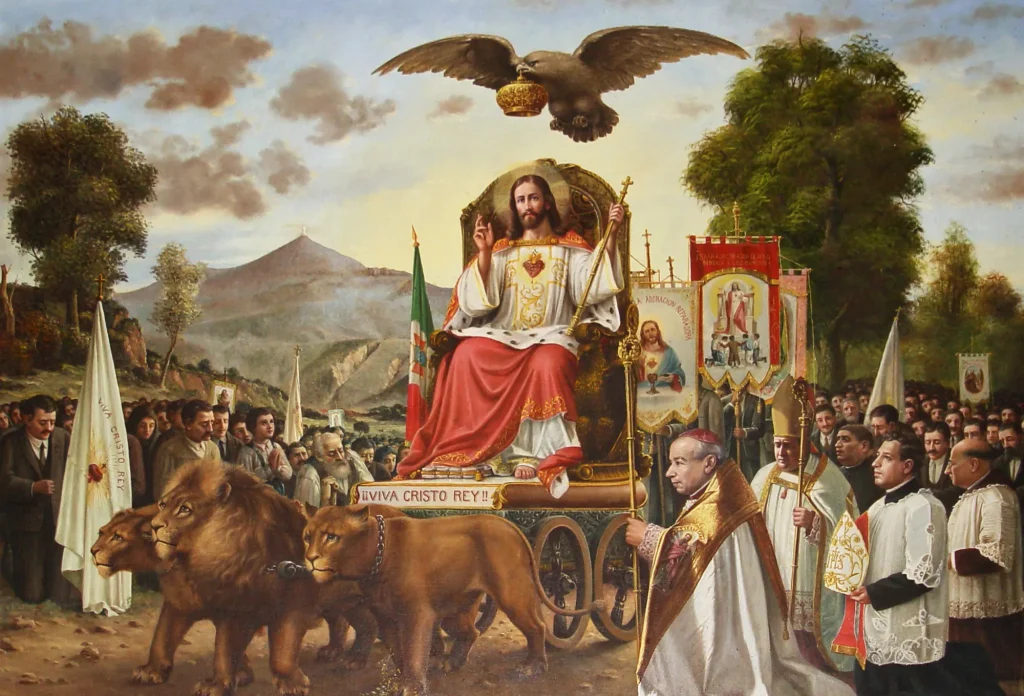
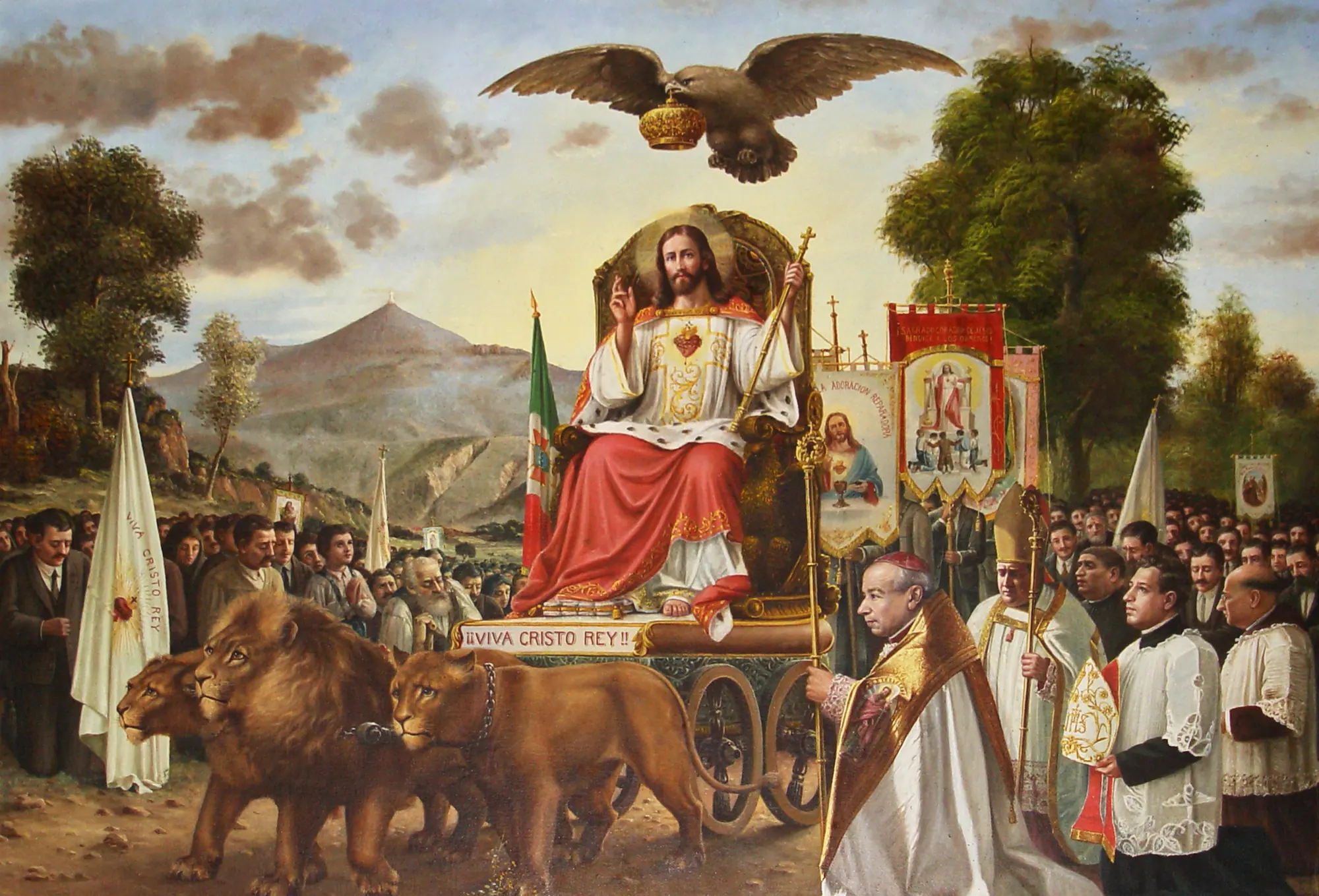
In 1924, as the Church in Mexico approached its most difficult years, the León painter Antonio Segoviano completed an allegorical painting inspired by Bishop Emeterio Valverde y Téllez. It became known as the Dream of Valverde, and today it is one of the most eloquent images in the Shrine’s history.
A King enthroned
The painting depicts the triumph of Christ the King of Mexico: the Sacred Heart appears enthroned as King of kings, in keeping with the vow the Mexican Bishops made in 1914 to build Him a national temple to pray for peace and preserve the faith. In the background rises the cone of Cubilete Hill, crowned by the silhouette of the King.
The symbols
An eagle carrying the imperial crown flies above the scene: it is the Mexican nation acknowledging Christ’s kingship. The lions represent the Diocese of León, the place the King chose as the seat of His throne.
Who appears
On the right, the painter portrayed those who contributed most to the work: Bishop Valverde y Téllez himself; the Apostolic Delegate Ernesto E. Filippi; Msgr. Amado Villanueva, bearing the mitre; the Carmelite Fr Eleuterio Ferrer, credited with the idea of the first monument; Fr Bernardo Chávez, apostle of the Sacred Heart in León; and Felipe Bravo Araujo, president of the Nocturnal Adoration in Silao.
The heart is the seat of love; the pierced Heart of Christ reveals the love God has for us.
At a glance
- Artist: Antonio Segoviano, painter from León.
- Year: 1924.
- Inspired by: Bishop Emeterio Valverde y Téllez, sixth Bishop of León.
- Theme: the triumph of Christ the King of Mexico.
Discover every detail in The Dream of Valverde and its panel.